lundi 9 novembre 2015

ELLIS ISLAND

ELLIS ISLAND


The Origin of the Island

From 1892 to 1954, over twelve million immigrants entered the United States through the portal of Ellis Island, a small island in New York Harbor. Ellis Island is located in the upper bay just off the New Jersey coast, within the shadow of the Statue of Liberty. Through the years, this gateway to the new world was enlarged from its original 3.3 acres to 27.5 acres mostly by landfill obtained from ship ballast and possibly excess earth from the construction of the New York City subway system.

Before being designated as the site of the first Federal immigration station by President Benjamin Harrison in 1890, Ellis Island had a varied history. The local Indian tribes had called it "Kioshk" or Gull Island. Due to its rich and abundant oyster beds and plentiful and profitable shad runs, it was known as Oyster Island for many generations during the Dutch and English colonial periods.
By the time Samuel Ellis became the island's private owner in the 1770s, the island had been called Kioshk, Oyster, Dyre, Bucking and Anderson's Island. In this way, Ellis Island developed from a sandy island that barely rose above the high tide mark, into a hanging site for pirates, a harbor fort, ammunition and ordinance depot named Fort Gibson, and finally into an immigration station.
A BRIEF HISTORY OF EVENTS :
1630
The Colonial governors of Nieuw Amsterdam purchased a small, 3.5-acre mud bank in Upper New York Bay, near the New Jersey shore. The Indians called it Kioshk, or Gull Island, after the birds that were its only inhabitants. The Dutch settlers called it Oyster Island, after the many surrounding oyster beds. The Island barely rose above the surface at high tide.
1776
By the time of the American Revolution, the Island was owned by Samuel Ellis, a New York merchant and owner of a small tavern on the island catering to fisherman.
 1808
Samuel Ellis's heirs sold the island to New York State. The name Ellis Island stuck. Later in the year, the Federal Government bought Ellis Island for $10,000.
1812
Shortly before the War of 1812, a battery of 20 guns, a magazine and a barracks were constructed on the island.

1890
The States turned over control of immigration to the Federal Government. The U.S. Congress appropriated $75,000 to build the first Federal immigration station on Ellis Island. Artesian wells were dug, and landfill (from incoming ships' ballast and New York City subway tunnels) doubled the size of Ellis to over six acres. While the new immigration station was under construction, the Barge Office on the Battery on the tip of Manhattan was used for immigration reception. During 1891, there were 405,664 immigrants, or about 80% of the national total, that were processed at the Barge Office.
1892
The first Ellis Island Immigration Station was officially opened. The first immigrant to pass through Ellis was a "rosy-cheeked Irish girl," Annie Moore, a teenager from County Cork. She came with her two younger brothers to join their parents in New York City. That first day, three large ships were waiting to land, and 700 immigrants passed through Ellis Island. In the first year, nearly 450,000 immigrants passed through the Island.

1897
A fire of undisclosed origin, possibly faulty wiring, completely destroyed the Georgia pine structures on Ellis Island. No one died, but most of the immigration records dating from 1855 were destroyed. In five years, some 1.5 million immigrants had been processed. While a new, fireproof immigration station was being constructed on Ellis, processing was transferred back to the Barge Office.
 1900
The present Main Building opened, an impressive, French Renaissance structure in red brick with limestone trim. It cost some $1.5 million and was designed to process 5,000 immigrants per day. This was scarcely big enough for the surge in immigration in the pre-World War I years. The island was continuously enlarged with landfill, remodeling, additions and new construction.
1907
This was the peak year at Ellis Island with 1,004,756 immigrants received. The all-time daily high was on April 17th of this year when a total of 11,747 immigrants were processed.

1921
Post-war immigration quickly revived and 560,971 immigrants passed through Ellis Island in 1921. The first Immigration Quota Law passed the U.S. Congress, adding to the administration problems at Ellis Island. It provided that the number of any European nationality entering in a given year could not exceed three percent of foreign-born persons of that nationality who lived in the U.S. in 1910. Nationality was to be determined by country of birth, and no more than 20 percent of the annual quota of any nationality could be received in any given month. The total number of immigrants admissible under the system was set at nearly 358,000, but numerous classes were exempt.
1924
The Immigration Act of 1924 further restricted immigration, changing the quota basis from the census of 1910 to that of 1890, and reducing the annual quota to some 164,000. This marked the end of mass immigration to America. The Immigration Act also provided for the examination and qualification of immigrants at U.S. consulates overseas. The main function of Ellis Island changed from that of an immigrant processing station, to a center of the assembly, detention, and deportation of aliens who had entered the U.S. illegally or had violated the terms of admittance. The buildings at Ellis Island began to fall into disuse and disrepair.

 
1938-1945
After the U.S. entered the war in December 1941, Ellis Island served primarily as a detention center for alien enemies, those considered to be inadmissible and others. By 1946, approximately 7000 aliens and citizens, with German, Italian, and Japanese people comprising the largest groups, were detained at Ellis Island. The detainees became so numerous that the immigration functions had to be transferred to Manhattan for lack of room. Ellis Island was also used as a hospital for returning wounded servicemen and by the United States Coast Guard, which trained about 60,000 servicemen there.

1950

A brief flurry of activity occurred on Ellis Island after the passage of the Internal Security Act of 1950, which excluded arriving aliens who had been members of Communist and Fascist organizations. Remodeling and repairs were performed on the buildings to accommodate detainees who numbered as many as 1,500 at one time.

1954
Ellis Island, with its 33 structures, was closed and declared excess Federal property.
1965
President Lyndon B. Johnson issued Proclamation 3656 adding Ellis Island to the Statue of Liberty National Monument, thus placing Ellis Island under the jurisdiction of the National Park Service.

1984
The largest restoration in American history was undertaken by the non-profit Statue of Liberty-Ellis Island Foundation, Inc., established in 1982 and chaired by Lee A. Iacocca, which raised all the funds from private citizens, corporations, and other groups and oversaw the restoration, working in partnership the National Park Service.
1990
The Ellis Island Immigration Museum opened to the public and has received over 40 million visitors to date. Also unveiled was The American Immigrant Wall of Honor®, the largest wall of names in the world, where individuals can have the name of an immigrant ancestor inscribed for posterity.


2001
The American Family Immigration History Center® was opened by The Statue of Liberty-Ellis Island Foundation, which allows visitors to the Center and its website to explore the extraordinary collection of records of the more than 25 million passengers and members of ships’ crews who entered the United States through Ellis Island and the Port of New York between 1892 and 1924.
2011
Journeys: The Peopling of America® Center, 1550 - 1890 the first phase of a major expansion of the Ellis Island Immigration Museum which explores arrivals before the Ellis Island Era, is opened by The Statue of Liberty-Ellis Island Foundation. Located in the historic Railroad Ticket Office, this exhibit highlights global reasons for immigration, describes both voluntary and involuntary forms of immigration, and underscores some of the historical debates and discussions about immigration in America.

2015
The second phase of The Statue of Liberty-Ellis Island Foundation’s Peopling of America® Center, which was delayed due to the damage sustained by Ellis Island from Superstorm Sandy, is scheduled to open. It will tell the story of arrivals to America in the post-Ellis Island era (1955-Present).

ORAL PRESENTATION : NEW YORK CITY

Special thanks to Sofya and Laetitia for their oral presentation on NYC

Sofya (left) and Laetitia


Laetitia 's DIY

A few American candies


vendredi 16 octobre 2015

ORAL PTRESENTATION

Alexandre (left) and Valentin
Thanks to Alexandre and Valentin for their oral presentation on Mount Rushmore


QUIZ  http://www.quizmoz.com/quizzes/Wonders-of-the-World/m/Mount-Rushmore-Quiz.asp

jeudi 8 octobre 2015

HISTORY


                              1 - The discovery of America

What do you know about the discovery of America ? Do the following quiz :
http://www.funtrivia.com/trivia-quiz/History/US-History---1---Exploration--Early-Settlement-156697.html


                            2 - Christopher Columbus 


How well do you know Christopher Columbus ? Do this quiz :


Do you know enough to make your teacher walk the plank ? Play this game !!!

http://www.schoolhistory.co.uk/games/walk/walk_columbus.html

Play another game !!
http://www.kibagames.com/Game/Discovery_of_America


POEMS AND SONGS      

When Columbus was a little boy,
He lived beside the sea.
He watched the ships sail in and out
And wished that he could be ______
A sailor, a sailor, to sail across the sea,
A sailor, a sailor, to skip before the breeze. 

**********************************
* 

FOR COLUMBUS DAY

Long ago most people thought
The world was flat.....we know it's not.
Columbus said, "The world is round!"
That's how America was found. 

*********************************** 

COLUMBUS
(sung to tune of "Eensy-Weensey Spider")
Columbus was a sailor who thought the world was round.
He asked for ships but many turned him down.
He went to ask the King and Queen of Spain,
And he told them of the gold and spices they would gain!

He had to wait six years for the king and queen to say,
"We'll give you ships so you can sail away."
It was the year of 1492
When Columbus sailed from Spain with his tough and able crew.

They sailed upon the ships out of sight of any land.
Things didn't go exactly as they'd planned.
They begged Columbus to turn and head for home.
But Columbus urged them onward across the sea and foam.

On October the 12th of 1492

A sailor sighted land and yelled to the crew!
Columbus went ashore and claimed the land for Spain,He was thankful that his voyage had not been made in vain.

vendredi 2 octobre 2015

Oral presentation :

Ajouter une légende
Special thanks to Jonathan and Guillaume for their oral presentation on Los Angeles


samedi 26 septembre 2015

THE USA : geography and general information

USA : geography and general facts


The United States of America is located on the continent of North America. There are 50 states in the U.S. Forty-eight of the states form the contiguous United States. The U.S. borders on Canada to the north, and Mexico and the Gulf of Mexico to the south. On the east coast, the U.S. is bordered by the Atlantic Ocean, and on the west coast it is bordered by the Pacific Ocean.

To the northwest of Canada is the state of Alaska. The state of Hawaii is located in the Pacific Ocean, southwest of California.

In addition to the 50 states, the U.S. has several territories and possessions, located in the Caribbean Sea and the Pacific Ocean.


 Play games to learn the names of the states & the capitals, etc... on sheppardsoftware.com 


NATIONAL SYMBOLS 


The Flag:
Flag of the United States.svg


4 different names : - The Stars and Stripes; 
               -  Red, White and Blue; 
               -  Old Glory; 
   - The Star Spangled Banner


eagle
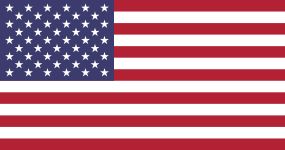
The U.S. flag has undergone many changes since the first official flag of 1777. On June 14, 1777 , the Continental Congress passed the first Flag Act, which said that the flag would be made up of thirteen alternating red and white stripes and thirteen white stars on a blue field. Stars have been added to the flag as new states join the union. Currently, the flag contains 50 stars.
Ever wonder why the flag is red, white, and blue? While the flag's colours did not have a specific meaning at the time, the colours were significant for the Great Seal of 1782.
White: Signifies purity and innocence
Red: Signifies valor and bravery
Blue: Signifies Vigilance, perseverance, and justice 

Why stars and stripes? Stars are considered a symbol of the heavens and the divine goal to which man has aspired from time immemorial; the stripe is symbolic of the rays of light emanating from the sun.
Facts About the U.S. Flag
How many stars and stripes are on the flag?
There are 50 stars representing the 50 states and there are 13 stripes representing the 13 original states.
Flag: thirteen equal horizontal stripes of red (top and bottom) alternating with white; there is a blue rectangle in the upper hoist-side corner bearing 50 small white five-pointed stars arranged in nine offset horizontal rows of six stars (top and bottom) alternating with rows of five stars; the 50 stars represent the 50 states, the 13 stripes represent the 13 original colonies;
Proper Display of Flag: 
* Display of the American flag is usually from sunrise to sunset.

* The flag should be displayed daily on or near the main building of every public place and during school days in or near every schoolhouse.

* Flags are flown at half-staff to show grief for lives lost. When the flag is flown at half-staff, it should be pulled to the top for a moment, and then lowered to the half-staff position. The flag should then be raised to the top before it is lowered for the day.
* When two or more flags are flown from the same pole, the American flag must be on top.
* When displayed with another flag against a wall, the U.S. flag should be on its own right (left to a person facing the wall).
flag


Anthem :

The Star-Spangled Banner" is the national anthem of the United States of America. 
Listen to it !: 


  The pledge of Allegiance :

The Pledge of Allegiance of the United States is an expression of loyalty to the federal flagand the republic of the United States of America:

"I pledge allegiance to the Flag of the United States of America, and to the Republic for which it stands, one Nation under God, indivisible, with liberty and justice for all."

Schoolkids all across the United States recite the Pledge of Allegiance at school, usually in the morning. But they don't have to


LIBERTY BELL


the Liberty Bell
Cast in London, England in 1752, the Liberty Bell rang when the Continental Congress signed the Declaration of Independence and has become the symbol of freedom in the United States. The bell weighs about 2000 pounds and is made mostly of copper (70%) and tin (25%).


                                               The Great Seal
On July 4, 1776, Benjamin Franklin, John Adams, and Thomas Jeffersonwere given the task of creating a seal for the United States of America. The delegates of the Constitutional Convention believed an emblem and national coat of arms would be evidence of an independent nation and a free people with high aspirations and grand hopes for the future. 
The Great Seal
 was finalized and approved six years later on June 20, 1782. The seal reflects the beliefs and values that the Founding Fathers wanted to pass on to their descendents. 


Observe side of the Great Seal

Reverse side of the Great Seal
Obverse side of the Great Seal
The American bald eagle is prominently featured supporting a shield composed of 13 red and white stripes (pales) representing the Thirteen Original States with a blue bar (chief) uniting the shield and representing Congress. The motto of the United States, E Pluribus Unum (meaning out of many, one), refers to this union. The olive branch and 13 arrows grasped by the eagle allude to peace and war, powers solely vested in the Congress, and the constellation of stars symbolizes the new Nation taking its place among the sovereign powers.

  
THE STATUE OF LIBERTY
 
the Statue of Liberty


Reverse side of the Great Seal
The pyramid signifies strength and duration: The eye over it and the motto, Annuit Coeptis (meaning He, [God] has favored our undertakings), allude to the many interventions of Providence in favor of the American cause. The Roman numerals below are the date of the Declaration of Independence. The words under it, Novus Ordo Seclorum (meaning a new order of the ages), signify the beginning of the new American era in 1776.
 
THE PRESIDENTS OF THE USA:

http://www.whitehouse.gov/photos-and-video/photogallery/the-presidents


Branches of Government
Diagram:  Branches of Government


Washington, D.C.Washington, D.C.: flag and map

Washington, D.C. is neither a state nor territory, but has a government that resembles both.
Capital City:
Washington, D.C. is the capital of the United States of America
Motto:
Justitia Omnibus (Justice for all)
Origin of District's Name:
Named after George Washington and Christopher Columbus
Location:
Between Virginia and Maryland on the Potomac River


 GET READY FOR YOUR TEST!!


Do this quiz : http://fr.quizity.com/play/quiz/6886/Grand_Quiz_sur_les_Etats-Unis_%C3%A9tats-unis_am%C3%A9rique_pays_anecdote